
|
July 1, 2024 Dear friends, This has been my first official day of retirement and it was fantastic! In fact, the last few months have been special, with many visits from former students and other friends - some of these folks shown below. Theresa and I will soon be traveling around the Western U.S. in our pick-up truck with our two Labs, Rosie and Daisy. We're going to camp, hike, swim, look at stars, and engage in other activities that we know nothing about! We are hoping that many microadventures await us. This has been a great job, in many ways. I am deeply appreciative to have had the opportunity to work with an amazing cohort of graduate students, postdocs, and undergrads who have worked with the Group over 34 years. This has been an incredibly fulfilling job. I am also grateful to all of our collaborators, here in the U.S and in Italy, France, Belgium, Germany, England, S. Korea, and Japan. It has been a blast, and an honor, to work together with each of you. I hope our paths will cross again in the future. Best wishes and warm regards to all of you, Reg Penner |

|
June 2024 More distinguished visitors from the Valley! Apurva and Yash with Reg and Theresa. Massive amounts of amazing Indian food were imbibed. |
|
Battery science alumni extraordinaire and Indian Feast! Theresa, Mya Le Thai, Gaurav, and Harveen. So good to catch up with old friends! |

|


|
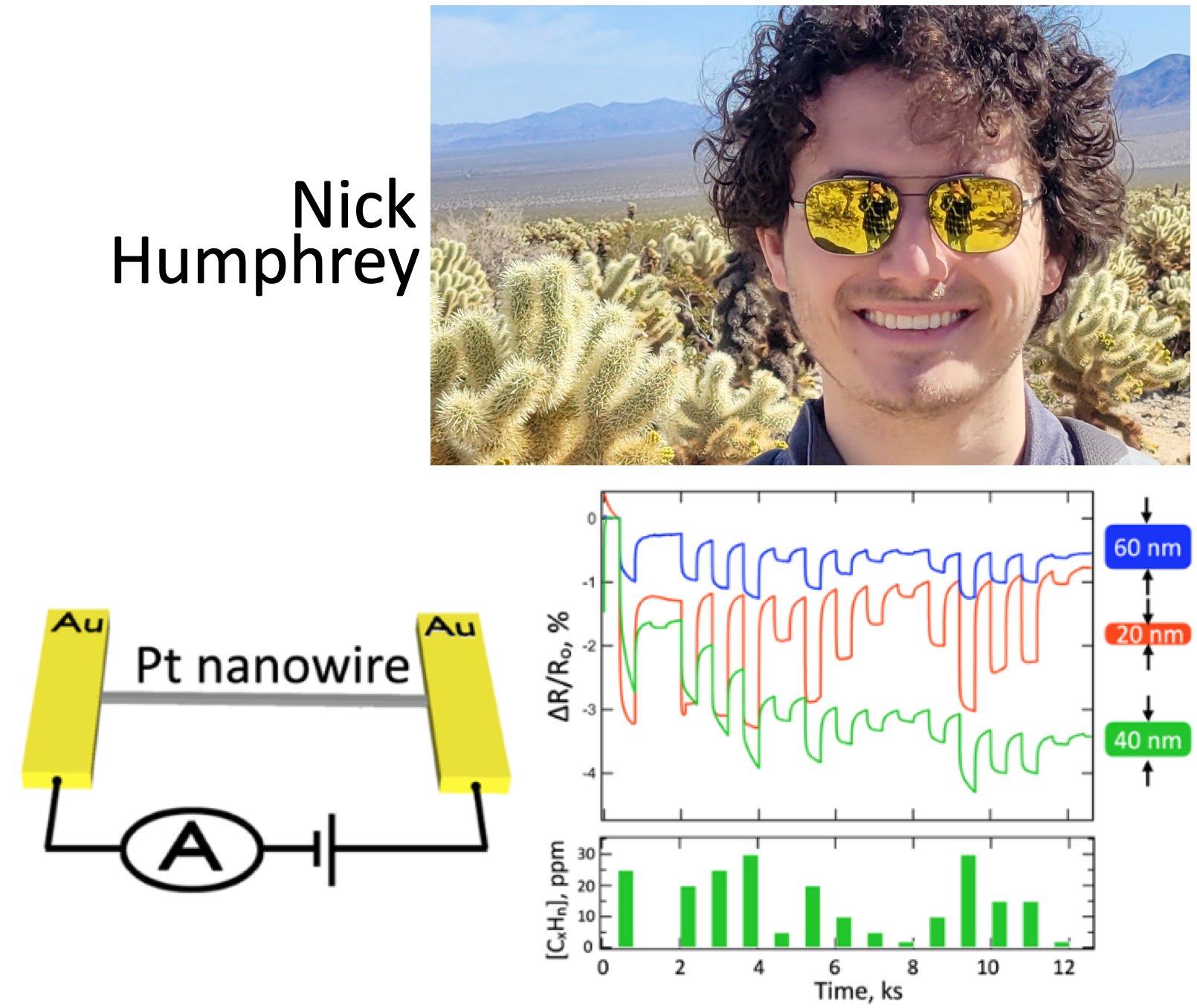
A Platinum Nanowire Sensor For Ethylene in Air Nicholas J. Humphrey, Eric J. Choi, Nicholas P. Drago, John C. Hemminger, Reginald M. Penner* ACS Sensors, ASAP (2023).  10.1021/acssensors.3c00885 10.1021/acssensors.3c00885
Rapid, accurate, and sensitive, ethylene sensors are needed because ethylene is odorless and C2H4:air mixtures are explosive above 3% ethylene in air. but existing sensing modalities can not enable hand-held, portable, and continuous ethylene concentration monitoring in air. To this end, a single platinum nanowire (PtNW) chemiresistive sensor for ethylene gas is reported. In this application, the PtNW performs three functions: 1) Joule self-heating to a specified temperature, 2) in-situ resistance-based temperature measurement, and 3) detection of ethylene in air as a resistance change. Ethylene gas in air is detected as a reduction in nanowire resistance by up to 4.5% for concentrations ranging from 1 to 30 ppm in an optimum NW temperature range from 630 to 660 K. |
|

|
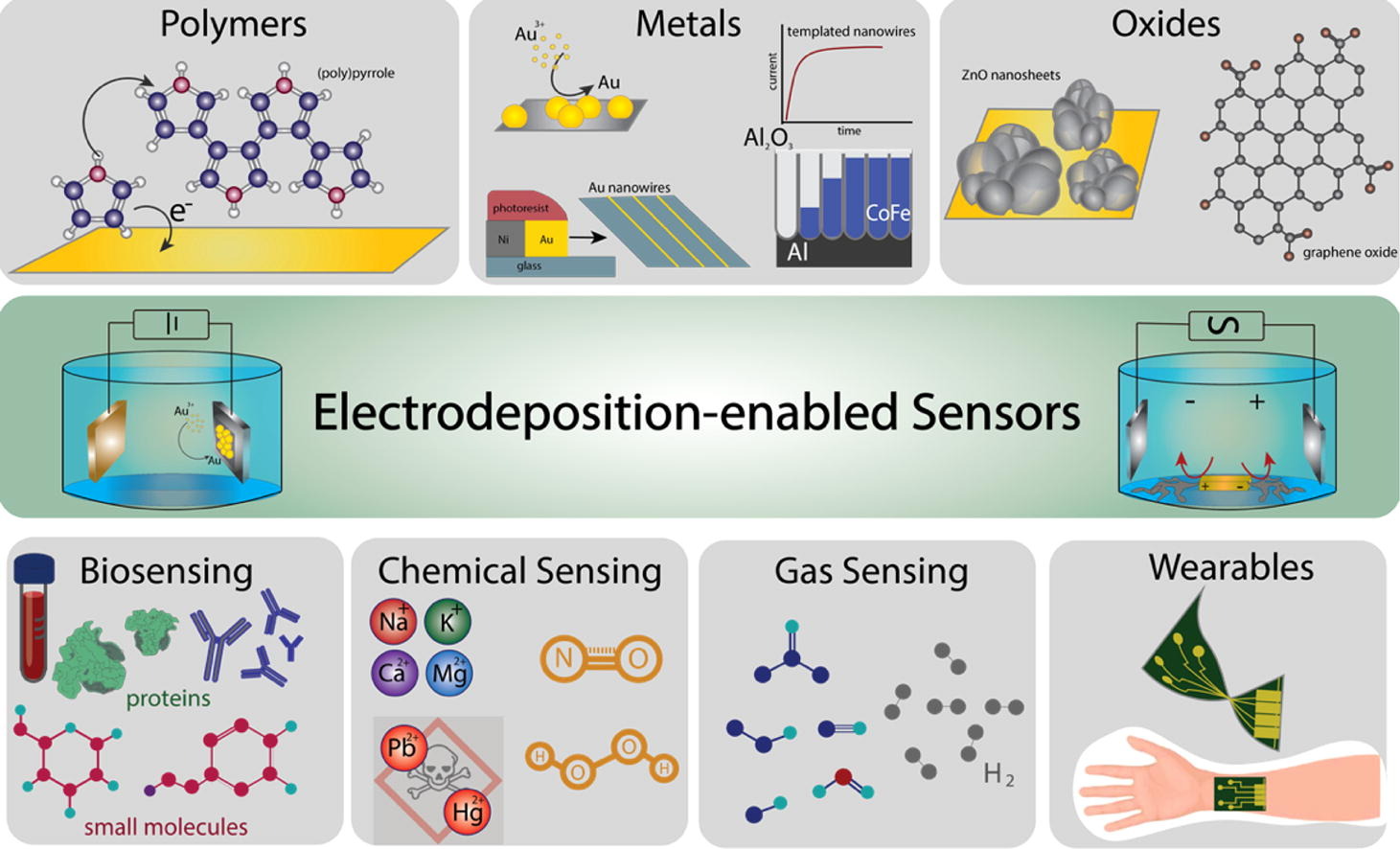
Electrodeposition-Enabled, Electrically-Transduced Sensors and Biosensors: 2017 - Present. Eric J.Choi, Nicholas P. Drago, Nicholas Humphrey, Justin Van Houten, Il-Doo Kim*, Alana F. Ogata*, Reginald M. Penner* Materials Today (2023) 62, 129 - 150. 10.1016/j.mattod.2022.11.021
For close to 100 years, electrodeposition (ED) has been used as a versatile tool for preparing materials of all kinds on the surfaces of conductors. Over the last forty years, the unique attributes of ED have increased its application to the fabrication and function of sensors and biosensors. These attributes are: Precise control of the quantity of electrodeposited material, control of surface roughness of the deposited surface and/or the porosity of the electrodeposite using the applied deposition current and/or the potential, and the incorporation of other non-electroactive molecules and nanoparticles, in some cases. The surprisingly diverse literature relating to ED and sensing is the topic of this review, which focuses on publications since January, 2017. |
|

research :: people :: publications :: teaching :: outreach
© 2026, Reginald M. Penner