The Villagrán group at UTEP addresses challenges in energy and environmental chemistry by developing advanced synthetic techniques to create novel materials at the molecular, surface, and nanoparticle levels. This talk will explore the rational design of molecular electrocatalysts for water oxidation, focusing on mechanistic studies of metal-free organic macrocycles such as porphyrins and phthalocyanines. Methods for the heterogenization of these catalysts through polymerization, compositing, and intercalation will be discussed as strategies to enhance the efficiency of the water-splitting reaction. A second major focus of our research is the study of fundamental chemistry principles in the development of sustainable water treatment. We will describe studies on the electrochemical reduction of PFOA, specifically the concerted reduction and defluorination mechanisms explored through electrochemistry, Marcus theory, and DFT calculations in both aqueous and organic media. We demonstrate how this foundational chemistry led to the development of engineered nanomaterials for efficient electrochemical treatment and selective sensing of persistent pollutants.
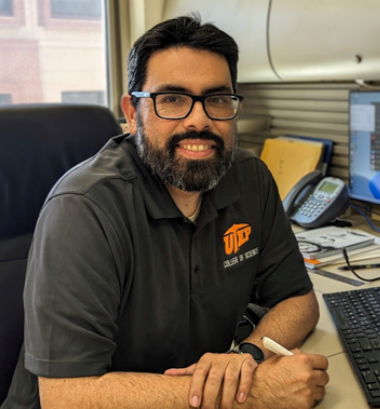
Vita: Dino Villagrán is a Professor of Chemistry at the University of Texas at El Paso (UTEP), where he earned his B.S. and M.S. degrees. He completed his Ph.D. at Texas A&M University, specializing in electron-transfer mechanisms and bimetallic systems, followed by a Camille and Henry Dreyfus Environmental Chemistry Postdoctoral Fellowship at MIT. Since joining the UTEP faculty in 2011, he has led a research program focused on the intersection of inorganic and physical chemistry. His work, which spans from fundamental molecular theory to applied materials for energy and remediation, is currently supported by the National Science Foundation, the Office of Naval Research, the Department of Energy, and the Welch Foundation.
Speaker:
Institution:
Location: