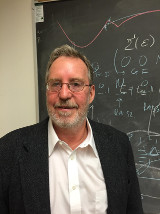
Professor Brooks is widely recognized as one of the pioneers of modern computational biophysics and biomolecular simulation. His work has profoundly shaped our understanding of protein and nucleic acid dynamics, folding, conformational transitions, free-energy landscapes, and drug-design, and has helped define the theoretical and computational foundations of biomolecular simulations. His group has also played a central role in the development and advancement of CHARMM, one of the most widely used biomolecular simulation programs. Professor Brooks received his Ph.D. in physical chemistry from Purdue University and carried out postdoctoral research at Harvard University with Nobel Laureate Martin Karplus. He is currently the Cyrus Levinthal Distinguished University Professor of Chemistry and Biophysics at the University of Michigan. In addition to his many scientific contributions, he serves as Editor of the Journal of Computational Chemistry and has held numerous leadership roles in the community, including serving as President of the Protein Society. He is also co-author, together with Martin Karplus and B. Montgomery Pettitt, of the classic monograph Proteins: A Theoretical Perspective of Dynamics, Structure, and Thermodynamics—often regarded as a foundational text, or “the bible,” of protein molecular simulations for generations of computational biophysicists. Professor Brooks has deep ties to Orange County. Earlier in his career he spent many years at The Scripps Research Institute, before moving there from Carnegie Mellon, both institutions where he helped train generations of computational chemists and biophysicists. Among them was our own Professor, and former Chair, Doug Tobias (who was actually Professor Brooks’s first Ph.D. student), and at least two (as far as I know) postdoctoral researcher advisees who later joined the UC Irvine faculty in other departments.
Speaker:
Institution:
Location: