
Department of Chemistry Professor Shane Ardo has led a team who, along with a team from Tel Aviv University, has developed a first-of-its-kind membrane through which charged molecules pass using nothing more than a rapidly switching low-voltage signal. This “ratchet-based ion pump” removes salt and other charged compounds from water efficiently and effectively. 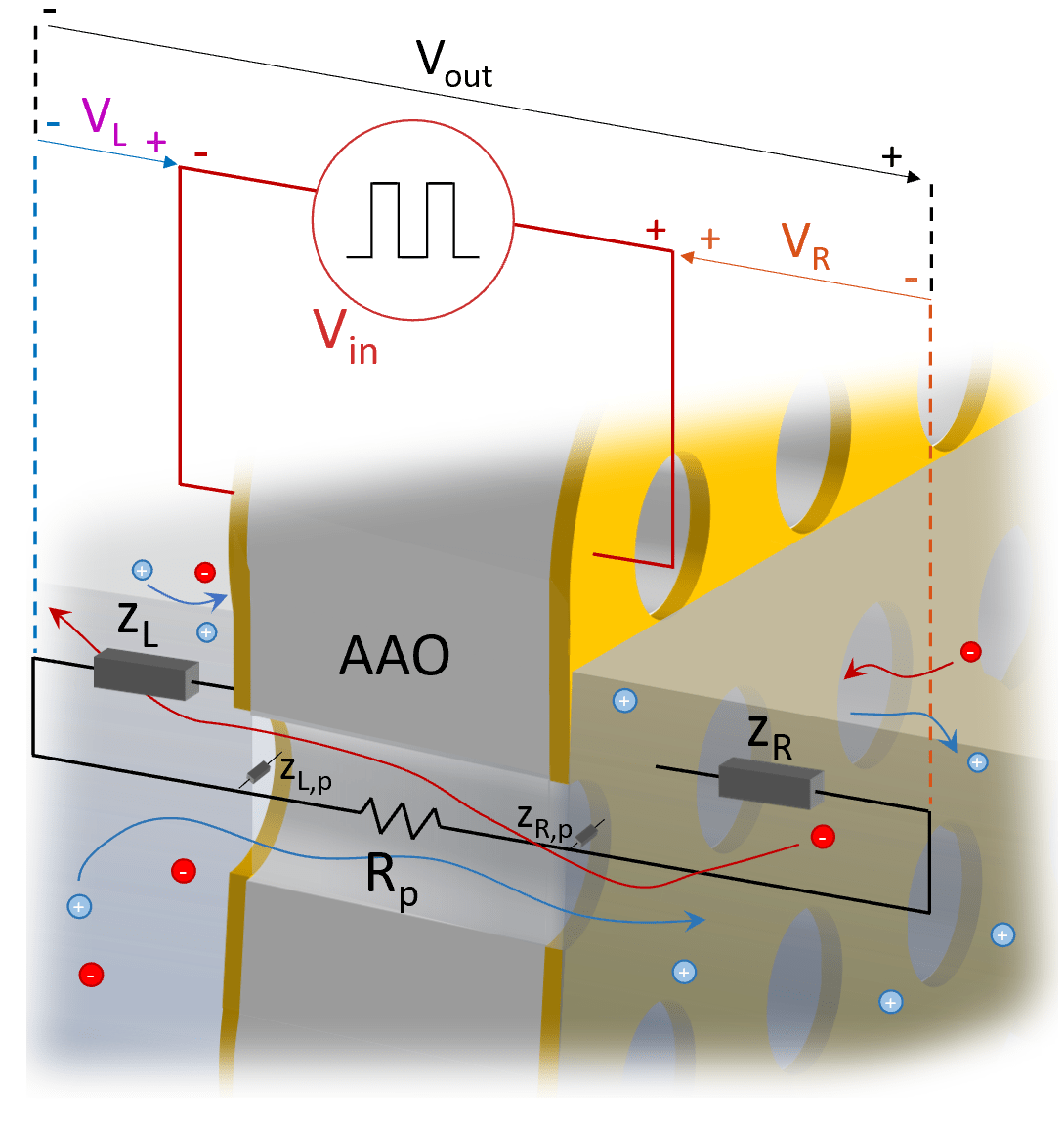
The ratchet-based ion pump works without moving parts or chemical reactions and opens the door to advances in water desalination, lithium ion harvesting from seawater, heavy-metal removal from drinking water, battery recycling and various biomedical applications. The team’s findings are outlined in a paper published recently in Nature Materials.
Controlling the movement of charged molecules through liquids is fundamental to various processes, ranging from industrial water purification to biological cell function. Until now, most engineered ion pumps have relied on energy-intensive electrochemical processes that impose significant efficiency limits and require complex and often costly chemistries.
The UC Irvine- and Tel Aviv University-led team has demonstrated an entirely different approach. Its ratchet-based ion pump exploits the unique electrical and chemical properties at the interface between metals and liquid electrolytes to drive an ionic current. By rapidly modulating the voltage between ultrathin metallic layers deposited on both faces of a membranelike, nanoporous, insulating wafer, the device generates a persistent and directed flow of ions across the membrane in what physicists call a ratchet effect.
“Ratchets are nonequilibrium devices that use temporally controlled input signals and spatial asymmetries to drive a steady-state particle flux,” said co-lead author Shane Ardo, UC Irvine professor of chemistry. “The combination of structural asymmetry and the unique nanoscale properties of metal-electrolyte interfaces provides the necessary ingredients that make the ratchet work.”
Read Professor Shane Ardo's publication in Nature Materials: A nanoporous capacitive electrochemical ratchet for continuous ion separations