Abstract:
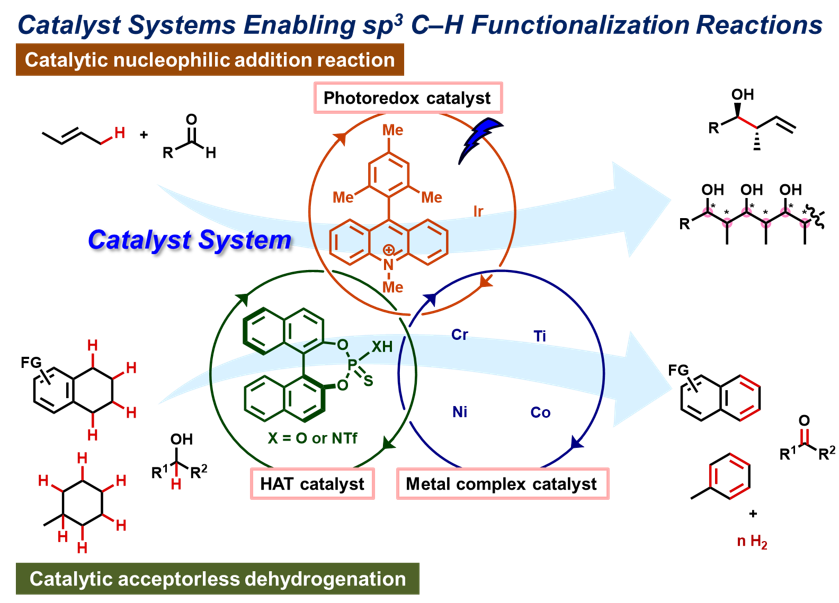
Catalytic functionalization of sp³ C–H bonds is an attractive strategy for the rapid synthesis of sp³-rich molecules with high atom and step economy. However, conventional transition-metal-catalyzed C–H activation often requires harsh conditions or directing groups, limiting its application to complex, multifunctional molecules. Although hydrogen atom transfer (HAT) catalysis enables cleavage of strong sp³ C–H bonds under mild conditions, controlling the reactivity and selectivity of the resulting carbon radicals remains challenging.
To address this issue, we developed a cooperative catalytic system consisting of a HAT catalyst for C–H activation, a transition-metal catalyst for selective bond formation, and a photoredox catalyst that electronically couples the two catalytic cycles. This ternary catalyst system strategy enables mild and selective sp³ C–H functionalization with broad functional-group tolerance and provides access to structurally complex molecules from simple hydrocarbon feedstocks. In this presentation, I will introduce new transformations enabled by these cooperative catalytic systems and discuss their potential applications in the synthesis of pharmaceutically relevant molecules.
Bio:
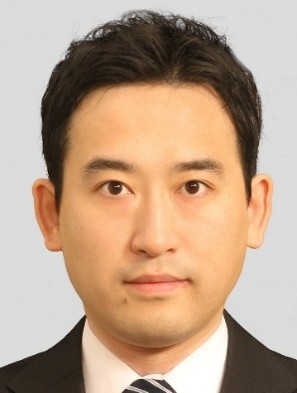
Harunobu Mitsunuma, Ph.D., is an Associate Professor and Principal Investigator in the Department of Chemistry at Kobe University. He received his B.S., M.S., and Ph.D. degrees from The University of Tokyo, where he conducted research with Professors Masakatsu Shibasaki and Motomu Kanai. During his graduate studies, he was also a visiting scientist in Professor John F. Hartwig’s group at the University of California, Berkeley. After completing his Ph.D. in 2015, he worked as a medicinal chemist at Sumitomo Dainippon Pharma before returning to The University of Tokyo, where he served as an Assistant Professor and a JST PRESTO researcher. In 2026, he launched his independent research group at Kobe University and was selected as a JST FOREST researcher.
His research focuses on the development of new catalytic strategies for organic synthesis, particularly photoredox catalysis, hydrogen-atom transfer (HAT), and transition-metal hybrid catalysis. His work has been published in journals including Science, Journal of the American Chemical Society, Nature Communications, Angewandte Chemie International Edition, and Chemical Science.
His honors include the 2026 MEXT Young Scientists’ Prize, the 2026 NAGASE Science Technology Award, the 2026 Thieme Chemistry Journals Award, and the 2025 Merck-Banyu Lectureship Award.
Speaker:
Institution:
Location: