
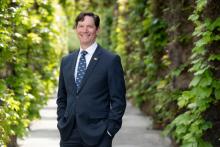
If you’re in the UC Irvine School of Physical Sciences and you haven’t met Seth Cohen yet, you will soon. Cohen’s the new dean of the school as well as a new distinguished professor in the UC Irvine Department of Chemistry, and he has plans to meet as many members of the UCI Physical Sciences community as he can during his first year. It’s part of his vision of what it means to be a leader: to serve each member of the school, because, he said, “their success is my success.”
The UC Irvine School of Physical Sciences Office of Communications caught up with Cohen to learn what we can all expect during his first year as dean.
This interview has been edited for brevity and clarity.
SoPS: Tell us your story before you came to UC Irvine.
SC: I’m a native southern California – I grew up in the San Fernando Valley. I was educated in the California public school system and earned both my undergraduate and graduate degrees in California. Professionally, before coming to UC Irvine, I was a professor of chemistry at UC San Diego for about 25 years. I was there for my whole career up until now, and I also spent two tours working for the federal government. My research falls into two areas: materials chemistry, and what is often called “metals in medicine,” which deals with the roles metal ions play in the development of new medical technologies. We study metalloenzymes, which are involved in many diseases, from viruses like influenza and HIV to cancer. My inorganic chemistry lab develops new ways of developing therapeutics that target metalloenzymes to develop new medical interventions.
SoPS: You’re the new dean of the school. What does being dean mean to you?
SC: I think it starts with service. It’s my job to serve various constituencies here in the school, as well as at the university. That includes the faculty, the staff, the graduate students and other trainees like postdocs, as well as the undergraduates. My job is to make sure they’re all getting what they need so they can excel – whether that’s an undergraduate excelling in their education and the next steps of their educational career, or faculty members getting new grants to support their cutting-edge research. My job is to help them progress to the next level of excellence.
I have a customer base here. I work for the students, and I work for the faculty. If the students are graduating with a good experience and then getting jobs they want or getting into graduate schools, then that means we’re doing our job right. And same goes for the faculty. If I do my job right, then the faculty are getting new grants, starting up companies, winning awards and getting internationally recognized. Everyone benefits. Their success is my success.
SoPS: Is being a leader a calling for you?
SC: Definitely. Even going back to high school, I was involved in student government, and I’ve always felt a calling to have a bigger impact, that if I could help people achieve their goals, then that was something I wanted to do. Back at UC San Diego, I was a very young department chair, and I’ve worked twice now for the federal government. To me that was very important, to give service back to the institutions that allow us all to do what we do.
SoPS: How do you think being a career scientist will inform your new role as a dean?
SC: I think it’s one of the most important things about being a successful dean. I think keeping my perspective as a faculty member — by still being a researcher and a mentor – I can always look at what decisions we’re making in the school, what priorities we’re establishing in the school, through the lens of a faculty member. Those kinds of decisions then trickle down to the grad programs, down to research programs, and down to undergraduate education. They’re all linked, and for that reason I think it’s very important to understand faculty needs, faculty concerns and how my decisions are going to impact them, because the faculty we hire is what makes this a world-class institution.
SoPS: What challenges do you see facing the school in the next few years?
SC: These are financially challenging times, and I’m trying to think strategically about how we can still all do the great things that we’ve done and more within the constraints we’re facing. Maintaining strong support for our graduate programs is challenging right now – but those programs are core to our mission. Graduate education is essential to what I think are the three pillars that make universities great: research, education, and community impact and outreach. I don’t think any of those can be strong without a strong graduate program, and so my focus — and I think the university’s starting to realize this, too – is how do we maintain that. The reputation of a university is built on many things, but very central is its research reputation, which is anchored by faculty, their graduate programs and the trainees that support that research. I want to make sure that we maintain our excellence in graduate training during these challenging times, and that we continue to innovate and to improve it.
SoPS: What about UC Irvine stands out to you as special?
SC: There are many special things about UCI. It’s incredibly successful for a relatively young university, it’s nationally recognized for promoting the economic and social mobility of its students, and it’s the premier educational institution in Orange County. For me personally, it has been the collegiality. People have been incredibly welcoming and friendly. Everybody talks about how they want to see me succeed, to help me to make the university better than it already is. Everyone from the students to the staff, the faculty, other deans, the provost and the chancellor – it’s been nothing but smiles, words and actions of support. Everybody’s saying “How can I help? What can I provide? How can we collaborate?” And that has been very, very special. It reminds me of how a rising tide floats all boats. Frank LaFerla, dean of the UCI School of Biological Sciences, told me the other day “I want to see you succeed because I want to see UC Irvine succeed.” That just warms my heart.
SoPS: What do you want everyone to know about you and what to expect?
SC: That I’m a straight shooter, that I’m genuine and that I’m going to put everything I ever learned – my decades of experience, the skills I’ve developed, my energy – into making this the best school it can be. I am dedicated to this job and am thrilled to be at UCI. I’m really passionate about making it the best school of physical sciences it can be. Not just in the UC system, but globally. That’s my goal. I’m solely focused on the success of this school in every way possible. I’m always going to think about that with everything I do here. Every move I make, every decision I make – how do we make this place even better than it already is.