Soluble organometallic complexes which are capable of delivering the metal atom, or mono-cation through facile, redox-neutral ligand exchange have been well-studied for over half a century. Representative examples of these include: [Rh(cod)2][BF4], [Ni(cod)2], and [Pd2(dba)3]. This chemical technology has become essential in the experimentalist’s toolbox when synthesising well-defined low-oxidation state complexes and is indispensable in catalytic systems for providing the transition metal source.1,2
Molecular complexes of iron in the rare +1 oxidation state have been shown to be efficient catalysts for industrially relevant chemical transformations, typically associated with the increasingly unsustainable noble metals. Unlike the examples above, iron does not have a suitable starting material in the privileged oxidation state and thus relies on the use of strong reducing agents (e.g. KC8, RMgX) for access.3
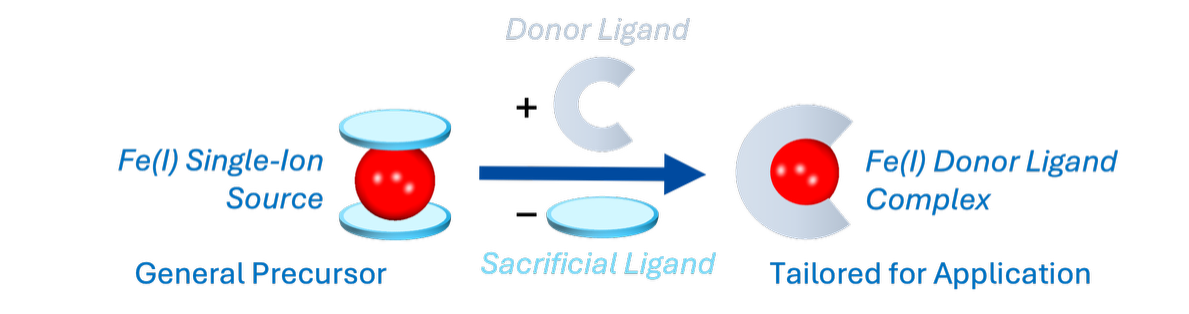
We have synthesised the first examples of Fe(I) single-ion sources which, on reaction with well-studied and commercially available ligands, have provided facile access to a library of 15 and 17 valence electron Fe(I) complexes. We have further demonstrated their use as drop in precatalysts for organic transformations.4
1. N. Hazari, P. R. Melvin, M. M. Beromi, Nat. Rev. Chem., 2017, 1, 1–16.
2. P. Etayo, A. Vidal-Ferran, Chem. Soc. Rev., 2012, 42, 728–754.
3. R. B. Bedford, Acc. Chem. Res., 2015, 48, 1485–1493.
4. L. Kink, R. Kruk, O. P. E. Townrow, J. Am. Chem. Soc., 2026, 148, 16255–16266.
Bio:
Oliver was born and grew up in the UK, he obtained his integrated masters degree (MChem) in Chemistry in 2018, which included research projects with Dr. George Kostakis, Prof. Geoff Cloke (FRS), and Prof. Richard Layfield. His masters project with Prof. Cloke concerned the synthesis and reactivity of uranium phenoxide complexes. He subsequently moved to the University of Oxford for his DPhil in Inorganic Chemistry in the groups of Prof. Jose Goicoechea and Prof. Andy Weller. This project, funded through an iCASE award with Shell, involved the development of the first Zintl cluster based homogeneous catalysts. During this time, he won the EPSRC doctoral prize, which funded a postdoctoral position in Oxford to continue the project in new directions. In 2022, Oliver moved to Germany as an Alexander von Humboldt postdoctoral fellow, joining the group of Prof. Sjoerd Harder at the Friedrich-Alexander-Universität Erlangen-Nürnberg. This project targeted M(0) synthons of the alkaline earth metals, using metal vapour synthesis to directly react the metals and ligands together, which resulted in the direct synthesis of a barium(0) synthon. In late 2024, he moved to the Institute of Nanotechnology, KIT, as a VCI Liebig fellow to found his junior research group. His current research interests involve the development of new chemical technologies, with or for organometallic compounds containing metals across the periodic table.
Speaker:
Institution:
Location: